What is soda ash?
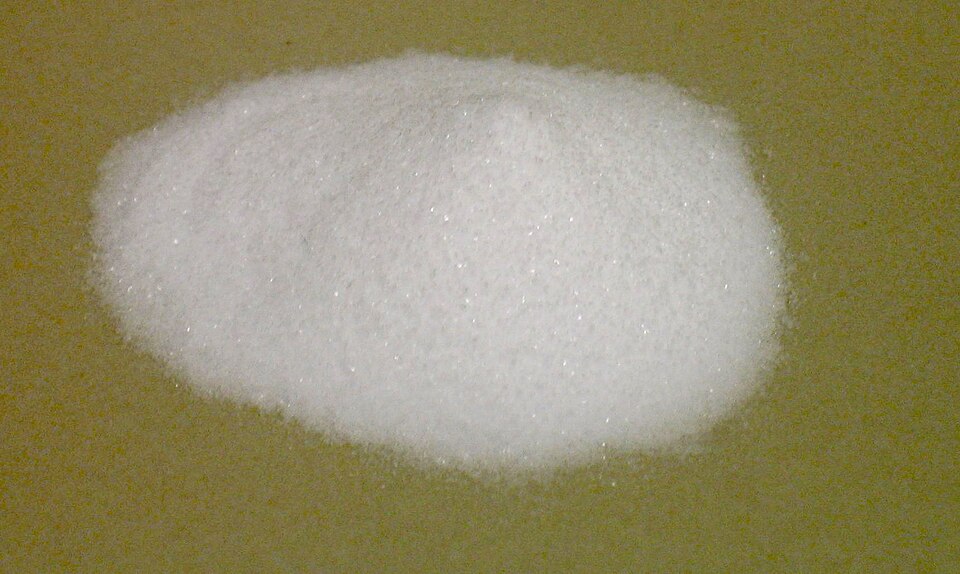
Soda ash is the commercial name for anhydrous sodium carbonate, formula Na₂CO₃, CAS 497-19-8: a white, odourless powder or granule that dissolves readily in water to give a strongly alkaline solution. Around 71 million tonnes a year move through global trade, making it one of the highest-volume inorganic chemicals on the planet — and one of the few where physical form matters as much as assay.
Chemically it is a sodium salt of carbonic acid — a moderately strong base that supplies carbonate alkalinity rather than the aggressive hydroxide alkalinity of caustic soda flake. That difference explains most of its industrial appeal: it buffers in the pH 10–11.5 region, is a dry solid at ambient conditions, is not skin-corrosive in the way sodium hydroxide is, and ships and stores with modest precautions. Where a process needs alkali but cannot tolerate the handling burden or pH overshoot of caustic, soda ash is usually the answer.
Two near-neighbours cause constant confusion in enquiries. Sodium bicarbonate (NaHCO₃, baking soda) is the milder relative that decomposes on heating to leave soda ash behind; caustic soda (NaOH) is a far stronger, corrosive alkali. Three distinct products, three distinct specifications.
Hydrates exist — the decahydrate is traditional “washing soda” — but industrial trade is almost entirely in the anhydrous salt, because every tonne of hydrate is a tonne of water you pay freight on.
Soda ash formula and key properties
| Property | Typical value |
|---|---|
| Chemical name | Sodium carbonate, anhydrous |
| Soda ash formula | Na₂CO₃ |
| CAS number | 497-19-8 |
| Synonyms | Disodium carbonate, calcined soda, carbonate of soda; washing soda (decahydrate) |
| Molar mass | 105.99 g/mol |
| Appearance | White odourless powder or granule |
| Melting point | About 851 °C |
| Water solubility | Freely soluble — around 20–30 g per 100 mL at room temperature, rising with temperature; insoluble in ethanol |
| Solution pH | Strongly alkaline; dilute solutions sit around pH 11 |
| Bulk density | Light roughly 500–720 kg/m³; dense roughly 1,000–1,200 kg/m³ |
Soda ash dense vs light: the difference that decides your grade
Dense and light soda ash are the same compound with the same assay. What separates them is bulk density, particle size and how the solid behaves in a plant — and confusing the two is an expensive specification error: a glass batch house fed light ash will dust and segregate, while a dissolving tank fed dense ash takes far longer to clear.
Light soda ash is the primary product of most production routes: a fine, low-bulk-density powder. It occupies roughly twice the volume per tonne of dense grade, carries a higher dust burden, and dissolves quickly thanks to its large specific surface area.
Dense soda ash is a coarser, granular, markedly free-flowing material. Synthetic producers make it by hydrating and compacting light ash, then sieving and classifying to a controlled size; natural producers take dense ash more or less directly from the monohydrate crystalliser and dryer. Either way the result is a granule sized close to silica sand, with low dust and about double the bulk density.
| Soda ash dense | Soda ash light | |
|---|---|---|
| Bulk density | ~1,000–1,200 kg/m³ | ~500–720 kg/m³ |
| Physical form | Granular, closely sized | Fine powder, broader fines content |
| Flow and dust | Free-flowing, low dusting | More cohesive, dustier |
| Dissolution rate | Slower | Faster |
| Typical users | Container, float and fibre glass; bulk chemical plants; silo and bulk-vessel logistics | Detergent powders; water treatment dosing; pulp, paper and textiles |
Which grade does your process actually want?
Glass takes dense, almost without exception. A glass batch must carry soda ash alongside coarse silica sand through weighing, mixing, conveying and furnace charging without the components separating. Fine light ash segregates from the sand and is lost to dust extraction, producing batch-to-batch variability in Na₂O; dense ash, sized close to the sand, stays mixed. Density also pays commercially: at double the bulk density, a silo, container or hold carries twice the tonnage.
Dissolving and blending duties take light. Where soda ash goes into a make-up tank for pH correction, or is dry-blended into a detergent powder alongside sodium tripolyphosphate and sodium metasilicate, the finer grade dissolves faster and blends more evenly with other fine powders. Plants dosing from a saturator or batch tank prefer light for the same reason.
There is no quality hierarchy: dense is not “better” than light, and both come in the same chemical grades.
How soda ash is made: Solvay, Hou and natural trona
Soda ash reaches the market by two fundamentally different routes, and roughly three-quarters of world output is synthetic. Of an estimated 71 million tonnes produced in 2025, about 52 million tonnes was synthetic and 19 million tonnes natural, according to the US Geological Survey. China leads at an estimated 38 million tonnes, mostly synthetic, followed by the United States and Turkey; those three account for about 80% of global supply.
The Solvay (ammonia-soda) process
The synthetic route starts from two of the cheapest minerals available: salt and limestone. Brine is saturated with ammonia and carbonated, precipitating sodium bicarbonate as the least soluble species in that system. The filtered bicarbonate is calcined to leave soda ash, with the carbon dioxide recycled to the carbonation towers. Ammonia is recovered from the filtrate using milk of lime made from the limestone, leaving a calcium chloride-bearing distiller effluent as the by-product. The overall transformation is:
2 NaCl + CaCO₃ → Na₂CO₃ + CaCl₂
The process is elegant in its ammonia recycling but heavy on energy, steam and effluent. The USGS notes plainly that synthetic soda ash is costlier to produce than natural and generates environmental wastes. A Chinese variant, Hou’s process, replaces the lime recovery loop so the by-product leaves as ammonium chloride fertiliser rather than calcium chloride waste.
The natural (monohydrate) process from trona
Natural soda ash comes from trona ore and from carbonate-rich brines. Trona is sodium sesquicarbonate, Na₂CO₃·NaHCO₃·2H₂O. The world’s largest deposit lies in the Green River Basin of Wyoming, with other significant resources in Turkey, Inner Mongolia, Botswana, Kenya and the California lake brines.
Ore is won by underground room-and-pillar mining — average recovery about 45%, per the USGS — or by solution mining at around 30%. Crushed ore is calcined to convert bicarbonate to carbonate; the crude ash is dissolved, clarified and carbon-treated to strip organics, then evaporated to crystallise sodium carbonate monohydrate, which is dried to anhydrous dense soda ash. About 1.8 tonnes of trona yields one tonne of soda ash.
Why the route shows up in your enquiry
The two are interchangeable in most applications and sell against similar headline assays, but they do not carry identical trace profiles: ore-, brine- and Solvay-derived material differ in chloride, sulphate, insolubles and organics, which producers control with route-specific purification steps. If your process is sensitive to any of them, say so in the enquiry and read the certificate of analysis rather than the brochure.
Soda ash grades and typical specifications
Most soda ash trades as a technical or industrial grade with total alkalinity expressed as Na₂CO₃. Published producer data sheets for industrial dense and light grades commonly specify 99.0–99.2% Na₂CO₃ minimum, some stating the equivalent as 58.0% Na₂O minimum, with tight limits then placed on the impurities that matter downstream.
| Parameter | What it controls | Typical commercial practice |
|---|---|---|
| Total alkalinity as Na₂CO₃ | Active alkali per tonne | Commonly 99.0–99.2% min, industrial grades |
| Chloride | Refractory and vessel corrosion; purity | Specified as a maximum; limits differ sharply by route and grade |
| Sulphate | Glass defects, scale, contamination | Tight maximum, typically a small fraction of a percent |
| Iron | Colour in glass and white formulations | Reported in ppm; tightest on flint and solar glass |
| Insolubles | Seeds and stones in glass; filter loading | Low maximum, grade-dependent |
| Moisture | Caking, flow, true active content | Low maximum, usually a fraction of a percent |
Treat the figures above as commercial practice, not a guarantee, and verify them against the supplier’s current specification and batch certificate of analysis. Beyond industrial grades, refined higher-purity material exists for photographic and electronic duties, and food-grade sodium carbonate is designated E500(i) in the EU additive system. Specify by use, not by assay alone.
Soda ash uses across industry
Soda ash is a true platform chemical, bought by industries with almost nothing else in common. The 2025 US end-use distribution reported by the USGS is a reasonable proxy for mature-market demand.
| End use | Share of US soda ash demand (2025 est.) |
|---|---|
| Glass | 45% |
| Chemicals | 28% |
| Miscellaneous uses | 9% |
| Distributors | 7% |
| Soap and detergents | 5% |
| Flue gas desulphurisation | 4% |
| Pulp and paper | 1% |
| Water treatment | 1% |
Glass
Soda ash is the flux in soda-lime glass. Silica alone melts at an impractical temperature; adding Na₂O from soda ash lowers that melting point dramatically, and lime is then added as a stabiliser because a pure soda-silica glass would be water-soluble. In a typical container-glass batch, soda ash is one of the largest single ingredients after sand, and container, float, fibre and solar glass all draw on the same dense grade. Because cullet carries its own Na₂O, rising recycled-glass rates reduce soda ash consumption per tonne of product — a structural demand factor worth watching over a multi-year supply horizon.
Chemicals
Chemicals is the second-largest consumer, and here soda ash is a feedstock rather than a processing aid: the sodium source for sodium silicate, fused from soda ash and silica sand; for sodium bicarbonate, sulphites, sodium sulfate and chromates; and, via lime causticisation, for chemical caustic soda as an alternative to the electrolytic product. It is also the standard precipitant for lithium carbonate from brine and spodumene leach liquors, tying a slice of demand to the battery supply chain. Most of these sit in the industrial chemicals range.
Soaps, detergents and cleaning
In powder detergents soda ash does three jobs at once: it supplies the alkalinity that saponifies fats, acts as a builder against hardness ions, and serves as a low-cost carrier and free-flow agent in the powder matrix. It is normally formulated alongside silicates and phosphates such as STPP or SHMP. Light grade is the norm here.
Water and wastewater treatment
Soda ash raises pH and, importantly, adds alkalinity — the buffering capacity that stops a treatment train crashing in pH when acid coagulants are dosed. Coagulation with aluminium sulfate or polyaluminium chloride consumes alkalinity, and soda ash replaces it without the handling burden of caustic. In lime-soda softening it works with calcium hydroxide to precipitate hardness, and it also serves corrosion control and effluent pH correction alongside the rest of the water treatment chemicals range.
Pulp and paper, textiles, flue gas and mining
Soda ash provides make-up alkali and pH control in pulping, bleaching and deinking, and in textile scouring and reactive dyeing, where carbonate alkalinity fixes dye without the sharp pH excursions caustic can cause. Sodium carbonate solutions and dry sorbents scrub sulphur dioxide and acid gases from flue streams. In metallurgy it is a flux and sulphur-removal agent, and in mineral processing a workhorse pH modifier in flotation circuits, dosed alongside the collectors and depressants in our mining chemicals range.
Packaging, handling and storage
Soda ash is commonly offered in 25 kg bags, in big bags and in bulk — pneumatic road tanker, rail hopper or bulk vessel — the choice driven by throughput and by whether your intake is a tipping point or a silo. Dense grade suits bulk and silo systems; light grade is more often bagged.
The dominant storage issue is moisture. Soda ash is hygroscopic and picks up water and carbon dioxide from humid air, which cakes bags, bridges silos and converts the particle surface toward bicarbonate and hydrate. Store under cover in a dry, ventilated area, keep bags closed and off damp floors, and rotate stock first-in-first-out.
The second issue is dust, particularly with light grade. Soda ash dust is alkaline and irritating to eyes and airways; most notified GHS classifications for sodium carbonate flag serious eye irritation (H319), and a proportion also flag respiratory irritation. Enclose or extract transfer points, and select eye, hand and respiratory protection from your own risk assessment rather than from habit.
Two further points belong in any handling review. Dissolving anhydrous soda ash in water releases heat, so make-up rates, tank materials and mixing should be set deliberately by a competent engineer. And soda ash reacts with acids to evolve carbon dioxide, which can pressurise a closed vessel, so segregate it from acid storage and other incompatible materials.
Obtain and read the current safety data sheet from your supplier before first use, and let it drive your risk assessment, PPE selection, materials of construction and emergency procedures. Nothing here replaces that document, and classifications vary between producers and grades.
What drives soda ash price and lead time
Soda ash is quoted, not listed: a low-value, high-volume commodity where the delivered number is assembled from several moving parts. No published figure will match what a specific tonnage to a specific port costs this month, so the drivers matter more than a price point.
Production route and energy. Synthetic capacity carries ammonia make-up, limestone, coke or coal, steam and effluent treatment, and the USGS states directly that synthetic soda ash is costlier to produce than natural. Energy and, in carbon-priced regions, emissions cost therefore move synthetic offers hardest; natural producers are exposed mainly to mining and calcination energy.
The global supply-demand balance. Recently the dominant factor. The USGS reports that global soda ash prices declined during 2025 on oversupply and weak demand from key consuming industries, attributing the trend largely to China’s expansion of natural soda ash output in Inner Mongolia, which added roughly 5 million tonnes a year of capacity in mid-2023. Construction, automotive and solar glass cycles sit on the demand side.
Grade, form and packaging. Dense and light are not priced identically, purity steps cost money, and bagging and palletising add real cost per tonne against bulk.
Freight and geography. For a commodity of this value density, logistics frequently rivals the ex-works component of the landed cost. Bulk vessel economics differ completely from containerised bagged cargo, and port handling, inland haulage and container availability all land in the final number. Origin matters, since the three largest producers are far from many consuming markets.
Substitution. Caustic soda can replace soda ash in parts of pulp and paper, water treatment and some chemical uses, and soda ash or trona can be converted into chemical caustic soda. Chlor-alkali economics therefore put soft bounds on soda ash pricing in those overlapping sectors, which is why buyers of caustic soda lye 50% and soda ash often watch both markets together.
Lead time follows the same logic: it is set by the producer’s production slot, the packaging format, vessel or container schedules and destination documentation — not by a fixed number of days. Specifying grade, packaging and destination early is the cheapest way to shorten it.
Specifying soda ash: what to put in the enquiry
A soda ash enquiry that gets a fast, firm answer usually contains five things.
- Dense or light — if unsure, describe the process step and let the technical team advise.
- Volume and call-off pattern — trial, monthly tonnage or annual contract.
- Specification limits that matter — assay, plus any of iron, chloride, sulphate, insolubles or moisture your process is sensitive to, and particle size or bulk density if your batch house or dosing system depends on it.
- Packaging and intake — bags, big bags or bulk, and whether you have silo or tipping facilities.
- Destination, Incoterms and documentation — including grade certification your end market requires.
Euro Chemical Supplies supplies soda ash in dense and light grades factory-direct, with batch documentation against each shipment. Send your specification, tonnage and destination through our contact page and the team will return a quotation with the matching product specification for review.