What is caustic soda?
Caustic soda is the commercial name for sodium hydroxide: formula NaOH, CAS 1310-73-2, EC number 215-185-5, molecular weight almost exactly 40 g/mol. It is the strongest alkali in everyday industrial use and one of the highest-tonnage inorganic chemicals in world trade. Wherever a process needs hydroxide alkalinity — to saponify a fat, dissolve lignin or leach alumina from bauxite — caustic soda is the reagent.
Caustic soda, sodium hydroxide, lye and sodium hydroxide lye all describe NaOH, and the loose terminology causes real ordering errors. "Lye" conventionally signals the aqueous solution, so liquid lye and liquid caustic soda are the same thing. What differs between line items is not the chemistry but the physical form and concentration, which drive freight, storage design and dissolving equipment far more than assay does.
This guide covers the three forms, the parameters separating grades, and what moves availability. Euro Chemical Supplies carries caustic soda flake, caustic soda pearl and caustic soda liquid in our industrial chemicals range.
Caustic soda formula and physical properties
The caustic soda formula is NaOH: one sodium cation, one hydroxide anion. In water it dissociates essentially completely, which is why it behaves as a strong base and why even dilute solutions sit high on the pH scale. Anhydrous NaOH melts at 318 °C (604 °F), dissolves freely and strongly exothermically, and is markedly deliquescent — it pulls both moisture and carbon dioxide from the air, the latter slowly converting surface material to sodium carbonate. That property explains most of the storage discipline the product demands.
For solutions, specific gravity tracks concentration closely enough for a works check — roughly 1.33 at 30% NaOH and 1.48 at 46% — but only titration gives a figure you can put on a batch sheet.
Caustic soda flakes vs pearls vs liquid lye
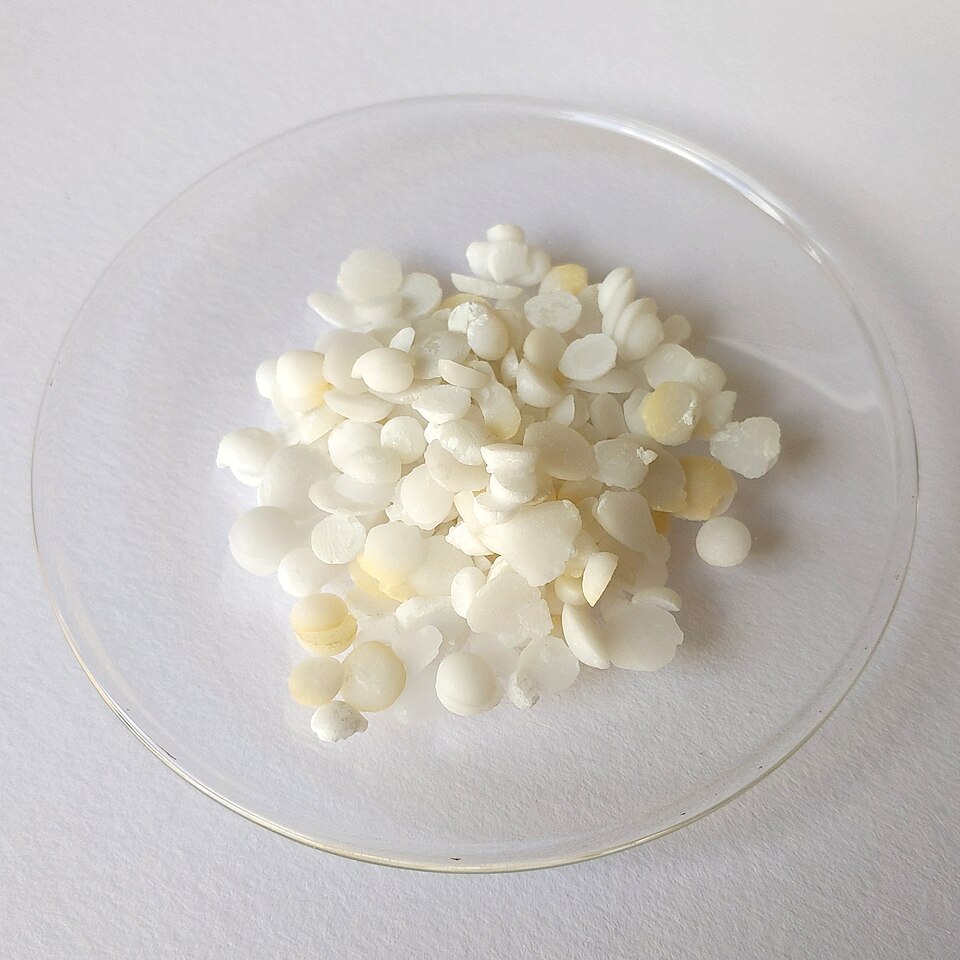
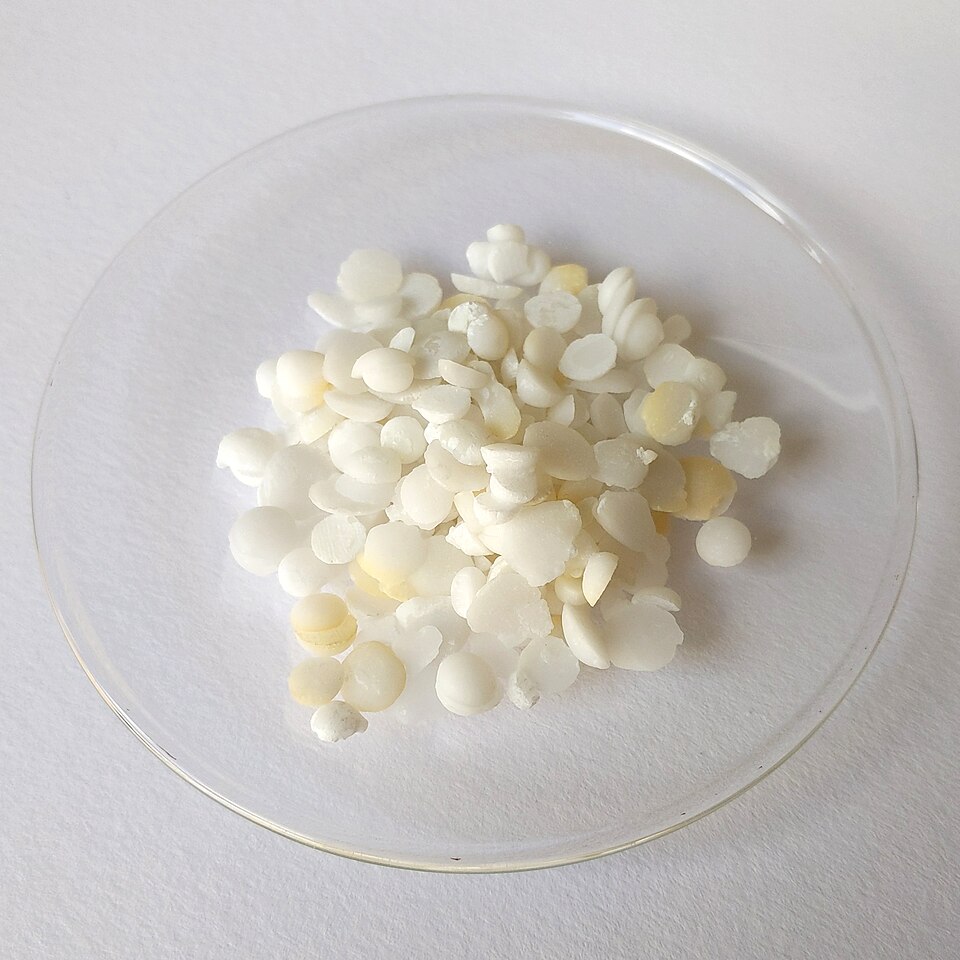
Both dry forms start as the same melt: 50% solution concentrated until effectively all the water is gone. Run that melt across chilled rolls and it sets as flakes; spray it down a prilling tower and it solidifies in flight as pearls, also sold as prills or beads. They differ only in particle size and shape, so what separates them commercially is physical.
| Flakes | Pearls | Liquid lye 32% | Liquid lye 50% | |
|---|---|---|---|---|
| NaOH content | ~98–99% | ~98–99% | 32% | 50% |
| Form | Thin platelets | Free-flowing spheres | Clear solution | Clear solution |
| Dissolving speed | Slowest solid | 2–3× faster | In solution | In solution |
| Freight efficiency | High | High | Low — 68% water | Moderate — 50% water |
| Crystallisation risk | None | None | Low | Begins near 12 °C |
| Heated storage | No | No | Rarely | Normally |
Caustic soda flakes
Flake is the default dry form and the cheapest to produce, which makes it the volume choice wherever caustic is dissolved by hand into a batch vessel — soap makers, textile finishers, small-batch chemical plants. Its drawbacks are purely mechanical: platelets interlock and bridge in hoppers, raise fines and dust, and dissolve more slowly than a sphere of equal mass because the thin plates mat together on a vessel floor. Irrelevant when an operator tips bags into an agitated tank; critical when material must feed unattended.
Caustic soda pearls and prills
Pearls cost more per tonne and buy you flow. A prilled sphere pours freely, meters accurately through rotary valves and augers, raises far less dust and dissolves appreciably faster: published comparisons at 5% concentration and 50 °F under constant agitation put flake grades in the low 40 seconds against roughly 15 seconds for beads — a step change, not a marginal gain. Where cycle time and dust control are design constraints, caustic soda pearl is usually the right call. Faster dissolution also delivers the exotherm faster, so size cooling for it.
Liquid caustic soda lye at 32% and 50%
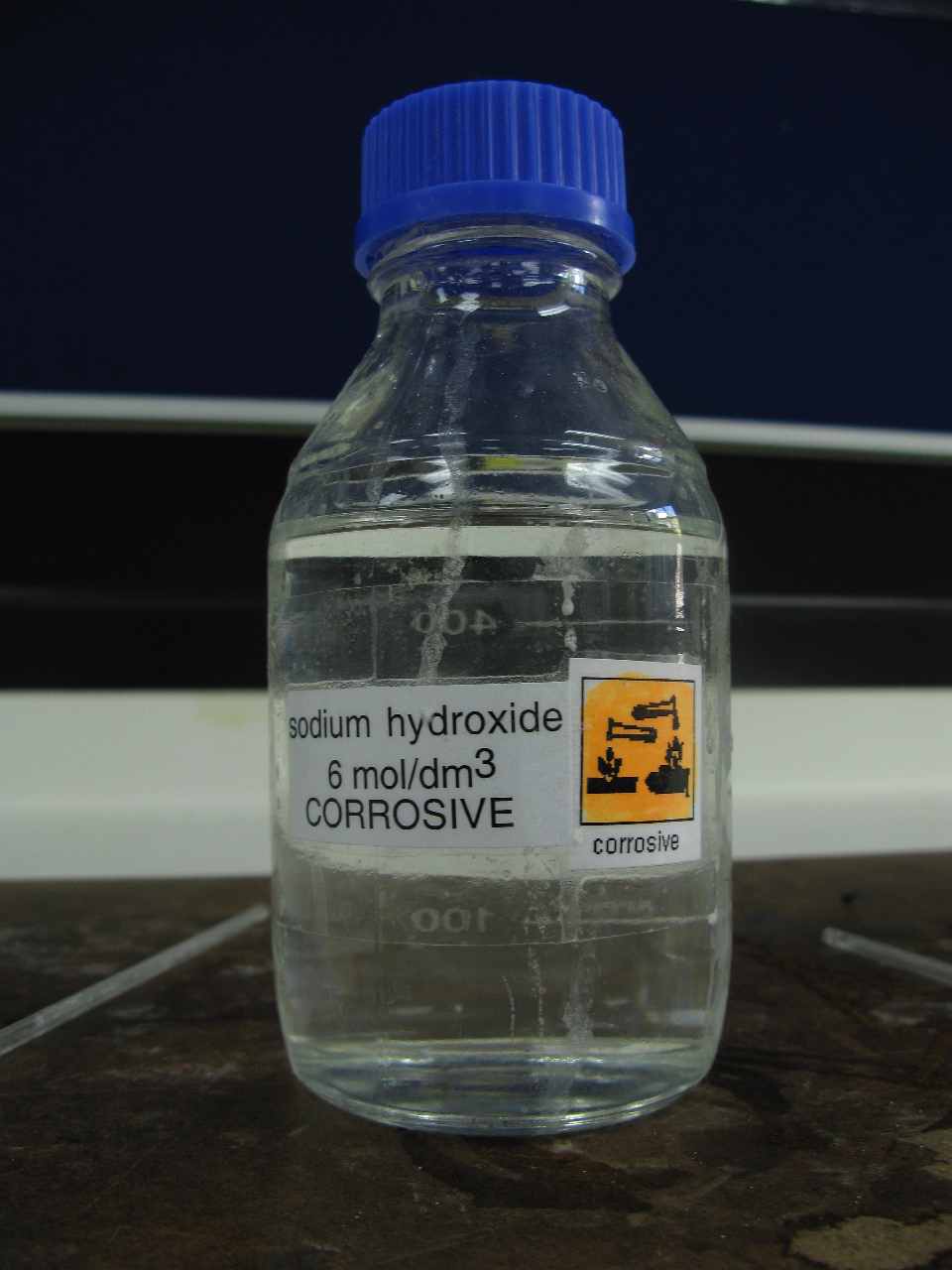
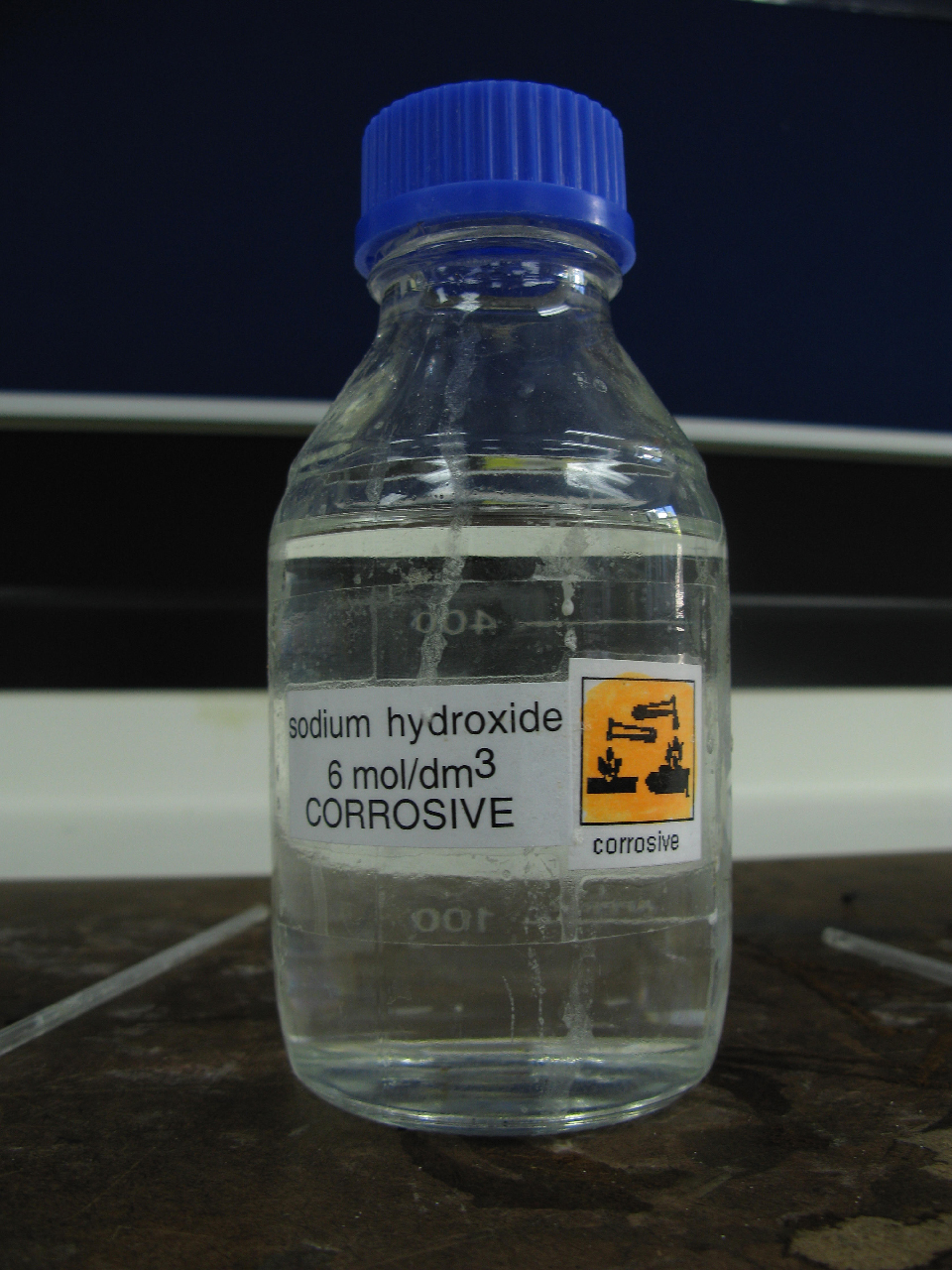
Solution strength is the biggest handling decision in caustic procurement. Liquid caustic soda lye 50% is the global bulk standard: what leaves the concentrators, what moves by tanker and rail, and what every large consumer takes. You freight half a load of water, but skip dissolving equipment, dust control and the hazards of handling a corrosive solid.
Liquid caustic soda lye 32% trades that freight efficiency for an easier life: it sits in an unheated outdoor tank, doses directly without dilution, and releases far less heat if mixed with water. Shipping 68% water a long way is poor economics, so 32% is usually a regional product, or something a larger site dilutes from 50% on arrival.
Why 50% lye crystallises and 32% does not
This catches out more first-time bulk buyers than anything else. Fifty per cent caustic soda begins to crystallise at about 12 °C (54 °F) — not a hard freeze, but the point at which sodium hydroxide hydrate starts dropping out of solution and building up in tank bottoms, valve bodies and dead legs. Twelve degrees is ordinary autumn weather across most of the inhabited world, so a 50% tank is a heated tank outside the tropics, with insulated, heat-traced lines warmed before transfer rather than after a blockage forms.
Dilute solutions behave completely differently: caustic soda up to roughly 30% stays liquid below 0 °C, which is why 32% lye survives a temperate winter in an unlagged outdoor tank. The reason is the NaOH–water phase diagram, which is not a simple downward slope. Each hydrate that can form has its own melting maximum, so the curve runs through peaks and valleys as concentration rises, and a few percentage points of strength can move it many degrees either way. Three consequences:
- Do not interpolate. Take the crystallisation figure for your exact concentration from the supplier's data sheet and design to it. Partial dilution is no guarantee either: letting 50% drift down a few per cent can land you on a hydrate peak rather than below it.
- Thaw gently, store warm. For a plugged line use low-pressure steam only, 10 psig or less; hotter steam on steel accelerates corrosion and pushes iron into the product. Hold storage at 27–38 °C (80–100 °F) — clear of crystallisation, cool enough not to attack the tank.
If crystallisation is your problem, ask whether you need hydroxide alkalinity at all: a carbonate alkali such as soda ash stores as a dry solid with far fewer precautions. Our guide to soda ash dense vs light covers where that substitution works.
How caustic soda is made: membrane, diaphragm and mercury cells
Caustic soda is not mined. It is produced by electrolysing sodium chloride brine, and chlorine and hydrogen come out of the same cell — a co-production that is the defining fact of the industry, shaping purity and price alike. Which of three cell technologies made your caustic is written into its impurities.
- Membrane cells. An ion-selective polymer membrane passes sodium ions while holding back chloride. Cell liquor leaves at around 30% NaOH and is evaporated to 50%. Membrane caustic is the purest route and the choice for new plants.
- Diaphragm cells. A porous diaphragm, historically asbestos, separates the compartments but does not block chloride. Cell liquor is weak, typically 10–12% NaOH, so far more evaporation is needed and the product carries roughly 1% sodium chloride. Energy-hungry, but still in service.
- Mercury cells. Sodium amalgamates with a mercury cathode, and the amalgam is decomposed with water to give 50% caustic directly. The caustic is low in chloride, but the mercury inventory is unacceptable: the EU required conversion by the end of 2017 and the Minamata Convention phases out mercury in chlor-alkali production globally, so it is now a rarity.
Why membrane grade matters for purity
The gap is not subtle. Fifty per cent membrane caustic typically carries under 100 ppm sodium chloride; 50% diaphragm caustic carries around 1%, roughly a hundred times more. For a pulp mill or alumina refinery that chloride is a non-issue; for anyone else it can be the whole specification. Chloride drives pitting and stress corrosion cracking, so feeding a percent-level chloride stream into a stainless circuit is a durability problem that surfaces years later. It also poisons catalysts and disturbs ion-exchange systems, which is why purified rayon grade exists. For food, pharmaceutical or potable water duty, trace metals matter as much as chloride. The lesson: "50% caustic soda" is not a specification. Ask which cell route produced it, and for the certificate of analysis.
Caustic soda grades and specification parameters
Liquid caustic is conventionally sold as diaphragm, membrane, rayon and purified diaphragm grades. A few parameters carry the commercial meaning.
| Parameter | Why it matters | Typical expectation |
|---|---|---|
| NaOH assay | Active alkali per tonne | Solids ~98–99%; solutions to stated strength |
| Sodium carbonate (Na₂CO₃) | Inert alkali from CO₂ pickup; blinds filters, scales | Commonly a few tenths of one per cent |
| Sodium chloride (NaCl) | Pitting and chloride SCC, catalyst poisoning | Under 100 ppm for 50% membrane; ~1% diaphragm |
| Iron (Fe) | Colour bodies, product staining, catalyst poisoning | Low single-digit ppm in good liquid grades |
Carbonate is as much a handling result as a production one: caustic absorbs atmospheric CO₂ whenever exposed, and agitating a dissolving tank with an air lance — a common shortcut — drives carbonate formation hard. Use a propeller agitator or recirculation pump.
Caustic soda uses: what is caustic soda used for?
Few chemicals span as many industries:
- Soap and saponification. NaOH hydrolyses triglycerides and neutralises free fatty acids to sodium soaps. Hard bar soap is the sodium salt; potassium hydroxide gives the softer potassium soaps used in liquids. Neutralising stearic acid directly is cleaner where colour matters.
- Pulp and paper. The kraft process cooks wood chips in white liquor — caustic plus sodium sulfide — to dissolve lignin and free cellulose fibre. Caustic also serves oxygen delignification and alkaline extraction alongside hydrogen peroxide, and de-inking.
- Textiles. Mercerising swells cotton fibre in strong caustic, permanently improving lustre, dye uptake and strength; caustic also scours waxes and pectins before dyeing.
- Alumina. The Bayer process digests bauxite in hot caustic liquor to dissolve aluminium as sodium aluminate, leaving iron and silica residues behind — one of the largest demand centres for caustic, and the most exposed to aluminium cycles.
- Water treatment. Caustic raises pH, converts aggressive dissolved CO₂ to bicarbonate and carbonate and adjusts alkalinity for corrosion control; as a rule of thumb 1 mg/L of NaOH shifts alkalinity by about 1.55 mg/L as CaCO₃. It is also standard for neutralising acidic effluent and scrubbing acid gases.
- Cleaning and CIP. Hot caustic is the backbone of clean-in-place in dairies, breweries and food plants because it saponifies fat and peptises protein. It is normally formulated rather than used neat, with sodium silicate or sodium metasilicate for metal protection.
- Biodiesel. Sodium hydroxide, usually as methoxide, catalyses transesterification of vegetable oils to methyl esters; feedstock free fatty acid content drives soap formation, so dosing control affects yield directly.
- Chemical manufacturing. Caustic is a sodium source and acid acceptor across countless syntheses, and the reagent that turns chlorine into sodium hypochlorite — both halves of the chlor-alkali output, recombined.
Handling, storage and PPE
Sodium hydroxide is severely corrosive to skin and eyes. Because concentrated caustic destroys nerve endings quickly, a burn can be advanced before pain registers, and eye contact can cause permanent damage in seconds. NIOSH applies a ceiling limit of 2 mg/m³ to airborne NaOH, with an IDLH of 10 mg/m³. None of this replaces the safety data sheet for the grade you have bought — read it, and keep it at the point of use.
The dissolution hazard
Caustic soda has a very high heat of solution: dissolving it in water can release enough energy to raise a batch to boiling, and that is the mechanism behind most caustic injuries in industry. Two rules govern it:
- Always add caustic slowly to the surface of water, with constant agitation. Never add water to caustic soda. Water hitting concentrated caustic flashes to steam and ejects a corrosive spray.
- Start with lukewarm water, around 27–38 °C (80–100 °F). Never hot or cold water. Hot water is already near boiling once the exotherm lands; cold water dissolves the solid too slowly, so it settles into a hydrate layer that then releases in a sudden, localised surge.
Adding solid caustic too fast, failing to agitate or letting it pile up can cause dangerous boiling and spattering, and in the worst case a violent eruption. Size cooling for the duty, and confirm most of a charge has dissolved before adding more.
Materials of construction
Carbon and mild steel handle caustic solutions acceptably at ambient temperature, hence most bulk tanks. Above about 50 °C (120 °F) corrosion accelerates, iron pickup contaminates the product, and concentrated caustic in steel that has not been stress-relieved risks caustic cracking. Where iron pickup is unacceptable, use epoxy-lined steel or 304L/316L stainless, good to around 93 °C (200 °F), and nickel alloys above that. Polyethylene, polypropylene, PVC and CPVC are compatible within their temperature ratings. Aluminium, copper, zinc, lead, brass and bronze are not suitable — caustic attacks all of them, and aluminium also liberates hydrogen.
PPE and facilities
- Chemical splash goggles as a minimum, with a face shield over them for transfers, sampling and line-breaking.
- Chemical-resistant gloves, apron or suit and boots, replaced immediately when contaminated; respiratory protection where dust, mists or hot caustic aerosols are present.
- Plumbed eyewash fountains and safety showers within reach of every unloading point, dissolving station and storage area; irrigate at length, as alkali burns keep developing.
- Keep solid caustic sealed; it is deliquescent and will cake and carbonate in open air.
- Bund tanks and keep dilute acid for residue neutralisation, but never neutralise a bulk spill directly: contain and collect first.
What drives caustic soda price and lead time
We quote caustic soda on request rather than publishing a figure, for a structural reason: its price moves on factors with little to do with caustic soda itself.
- The chlorine co-product relationship. One electrochemical unit yields about 1 tonne of chlorine, 1.1 tonnes of caustic soda and a little hydrogen, in a fixed ratio no producer can adjust. Because chlorine is the harder product to place, it sets how hard the cells run: strong chlorine demand with weak caustic demand floods the caustic market, while weak chlorine demand throttles cells and tightens caustic even when caustic demand is healthy. Caustic is, in effect, priced by the vinyls chain.
- Energy. Electrolysis is power-intensive and electricity is the dominant conversion cost, so regional power prices set regional caustic economics. Concentration adds more: cell liquor to 50%, and 50% to flake or pearl, is all evaporation, and steam costs sit behind the premium dry forms carry.
- Form, grade and packaging. Caustic is heavy, corrosive and classified for transport, so distance punishes dilute solutions while dry forms travel well but need dissolving on arrival. Membrane and purified grades cost more than diaphragm, pearls more than flake, and drums, IBCs, flexitanks and bulk tankers all price differently.
- Turnarounds and outages. Chlor-alkali plants are large, few and capital-intensive, so one unplanned outage tightens a whole region.
Lead time is likewise driven by form, packaging and origin rather than by availability of the chemical.
Specifying the right caustic soda for your plant
Reduced to essentials: 50% liquid lye for bulk consumption with heated storage; 32% lye to dose directly without heating; flake for manual batch dissolving at the lowest cost per tonne of NaOH; pearls where material must flow and dissolve through automated equipment. Then specify the grade separately from the form.
Tell us your application, the concentration and grade you need and the packaging that suits your site, and we will come back with a quotation and specification sheet. Request a caustic soda quote.